How AI Has Changed the Research Spectrum: The Rise of the AI Research Tool

There was a time when research was all about wading through piles of printouts and an array of open browser tabs, with notebooks that never seemed to tell the same story. The tedium of sifting through fifty pages of notes to track down a single quote is a frustration familiar to many. In recent years, however, one sees a different scene.
An AI research tool has taken its place as the focal point for how information is put together and made sense of. Such a tool is not just a repository for facts but something that links them in ways that were not possible before. For the writer, the analyst or the student who has to process considerable amounts of material, this is no small matter.
The whole landscape of research has been transformed from what it was five years back. We will examine here what has changed and the reasoning behind it and put forward how an AI solution can alter the course of a typical day’s work.
From Manual Notes to the Modern AI Research Tool
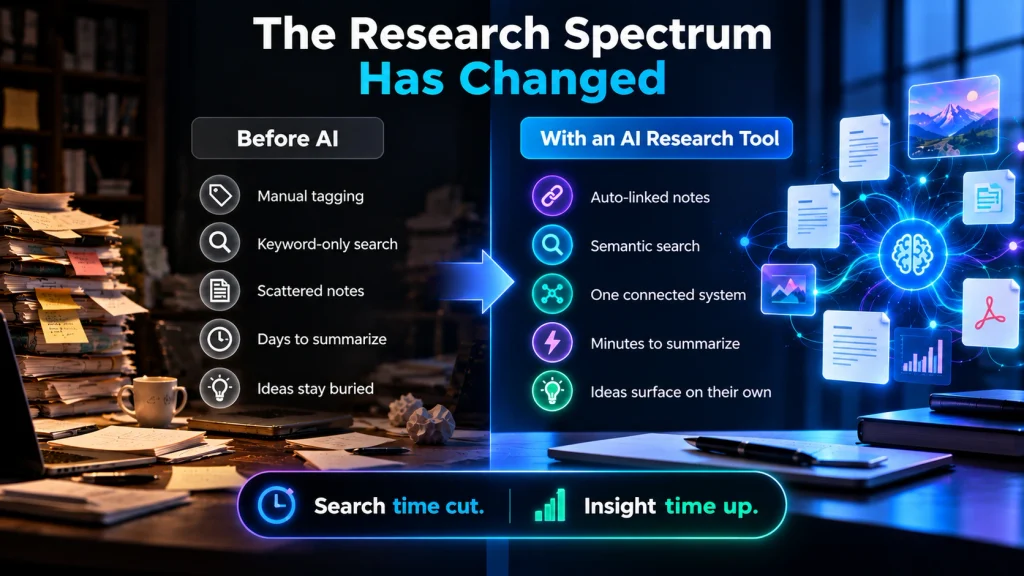
In the old days of research, one put in the manual work. A source would be read and a summary penned down for the folder. To come by that summary later required knowing precisely where it was put; too often, good insights were left to go to waste.
There is less of that kind of friction with an AI research tool. The system will read through material, cull the key points and make its own connections between ideas. It can even field questions on a set of notes so there is no need to reread them by hand.
Of course, we did not get here in a day. Search engines paved the way for easier access to information, followed by note-taking apps with their tags and folders. Today’s AI models can read and reason over text as a research assistant might. The result is that researchers have more time for thought and less for the hunt.
Real-World Speed Gains
You will find this kind of shift has been put in place by product teams, newsrooms and universities alike. Take a market analyst: with the system at hand, he or she can put in dozens of reports, and have it produce a summary of the pricing trends they show. It is a matter of minutes where days were required in the past. The implications are anything but minor; it is a change that dictates how quickly a team can act on what they learn and come to a decision with confidence.
Why Every Digital Note Taking App Is Adding AI
A few years ago, a digital note taking app mainly stored text. In the past, one would type up a note and put it away in the same fashion as with paper. Search was a matter of exact keywords; put “Q3 budget” in the title and do not expect to find it under a query for “third quarter spending.”
Such constraints have forced an evolution in the category. Today you will find some measure of AI in almost any note app, be it for search, to offer a summary or make link suggestions. Users have come to want their notes to be responsive, and what was once an extra is now simply the standard.
The Hidden Cost of Manual Search
One can see the logic behind this change. A knowledge worker will put in a good portion of the week simply to track down information of his or her own making; over the course of a career, that is time well and truly wasted. But with a note app that grasps the meaning of what is written rather than the precise words, such searches are a thing of the past.
Today it is possible for web clippings, voice recordings and meeting transcripts to all be channeled into one system, so nothing is left behind in some other tool. In effect, the distinction between “knowledge” and “notes” is becoming a moot point.
Understanding Semantic Relationships in Research
You will hear the term Semantic Relationships used with some frequency in this field. It is a way of characterising the links between ideas that are rooted in meaning rather than in any common vocabulary.
Take two notes for example: one on “customer churn” and another on “subscription cancellations.” A conventional keyword search would have no way of associating them, as there is not a word in common between the two. They are of a piece, covering the same concept. But a tool with true semantic understanding can make that link and put the notes together without any prompting.
Why This Changes Daily Research
In practical terms, this is a shift in how research is done. There is no longer any need for a person to go through and hand-tag each note with the proper keywords; one can put pen to paper in a natural fashion and allow the system to pick up on the patterns. The result, as it accumulates, is something of a genuine knowledge network, not unlike the way the brain makes its own connections between memories.
For those accustomed to the old way of things with inflexible folders, there is now room to let an idea come forward unassisted. It is particularly useful on extended projects where you might find an unexpected tie between an early observation and a more recent finding. The semantic tools will uncover such links without the tedium of manual labour, which is a welcome saving of time and effort.
Personal Knowledge Management Gets a Brain Upgrade
The field called personal knowledge management has existed for decades under different names. There is a long history of people wanting to make their learning something they can use again.
In the day, one might have relied on index cards or binders for that; more recently it has been digital folders. Each had its time.
The real shift has come in the form of an intelligence layer over and above the storage. Personal knowledge management was once a matter of sheer discipline. Let up on tagging your notes with any regularity and the system would be undone. AI has altered those terms. The organizing is largely done by the system now, so a lapse in discipline will not see the whole thing come apart.
Who Benefits Most
For those with a few active projects on the go, this kind of change is of particular importance. Take a freelance writer during five pieces: an AI can be left to collate the relevant material, sparing them the chore of manually putting together five distinct folder trees. Or a graduate student at work on a thesis might put a question to their system and have it show how a given concept is treated in a hundred different sources.
Then again, there is no substitute for critical thinking. What these tools do is get rid of the busywork, allowing one to devote attention to original thought and sound judgment. Even with automatic retrieval, any worthwhile research will rest on human reasoning in the end.
Socratus: A Connected Knowledge Graph for Researchers
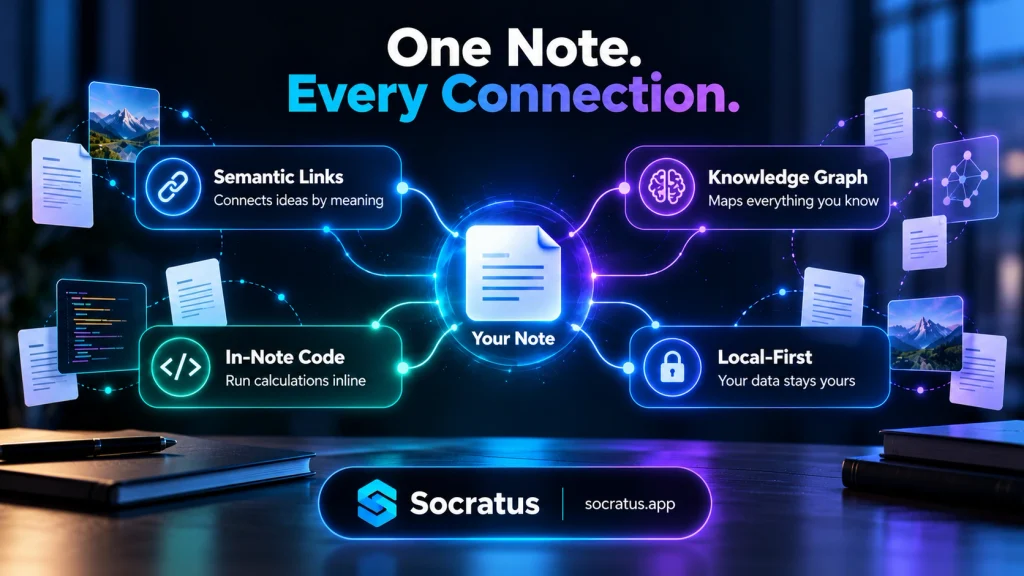
Socratus is perhaps the most notable of the tools created for this new area of research. It makes short work of the connection problem by not viewing notes as separate files; instead, it constructs a knowledge graph in which one can visually trace the relationship between ideas.
What sets the platform apart is the way it marries an AI retrieval system to a writing environment.
In Socratus, a thought put down on paper is at once mapped against the rest of what is known. The result is that notes are no longer simply text in storage, but material that is properly comprehended.
Built-In Tools for Deeper Work
With Socratus, in-note code execution is an option. It is a useful feature for those who must deal with data as well as written analysis; a researcher might put in a calculation and run it beside the relevant notes without having to go back and forth between different applications.
Then there is the question of privacy, which is not to be taken lightly in serious research. Socratus is local-first by design, so one’s information remains on the device at hand and is not left to the mercy of some remote server. That is a meaningful difference when sensitive material is involved. The platform has MCP integration as well, giving other AI assistants and workflows live context from your notes.
To get an idea of what a connected knowledge graph look like in contrast to the old folder-based way of doing things, one can look at Socratus.
Research Across Different Fields
You will find the move to AI in research is not confined to a single sector. In academia, for instance, scholars put these systems to work to follow the progression of an argument through a score of papers. Journalists have them on hand to do in a fraction of the time what would otherwise be a lengthy cross-referencing of interview material with public records.
Then there are product teams who employ the technology to set customer feedback up against their internal roadmaps; it is a way of unearthing discrepancies that might have gone unnoticed in a tangle of spreadsheets. The advantages extend to the small business as well. A shop owner has no need to manually piece together supplier notes, pricing and customer demands when a system can make those connections for him.
A Pattern Worth Noticing
You will find a common thread in all these examples. It is the fact that people are devoting less of their time to the search and more to making decisions. The same can be said for an analyst or a reporter as it is for a teacher or the owner of a small business. Not many technologies have the effect of altering so many different roles in one go; when they do, it is typically because there was an unmet need that the previous crop of tools could not address.
In this case, the need was to bridge the divide between simply having information on file and coming to a true understanding of it.
Trust and Accuracy in AI-Assisted Research
There is not much value in speed when one cannot put faith in the results. In this regard, accuracy and transparency are just as important as automation. An AI research tool of any worth will make clear the provenance of an answer; it should be more than a summary delivered with false confidence and no source to back it up.
Source links and citations are essential. The system ought to direct the user to the original document or note so that a claim can be verified on its merits rather than accepted on faith. That is the only way to counter the tendency of some AI to produce information which has the ring of truth but is in fact incorrect.
Reliable research comes from teams that make such verification part of their workflow instead of an afterthought, and that remains the case even as the work grows ever more automated.
Signals of a Trustworthy Platform
Then there is the matter of experience. A team with a firm grasp on how research is done will put together tools that can cope with edge cases, in a way that one cobbled together for a tech demo cannot.
One should also be on the lookout for features such as transparent linking, local storage and unambiguous citations; they are telltale signs of a platform built on trust rather than mere novelty. It is wise to check for these things before making a long-term commitment to a new system for one’s notes.
How to Choose the Right AI Research Tool
The sheer number of systems available on the market makes for a daunting selection process. But one need only ask a handful of practical questions to whittle down the choices.
Start with the search function: is it a matter of exact keywords, or does the tool have the capacity to pick up on context and meaning? Then there is the question of privacy. While some solutions put everything in the cloud, others are content to keep data local.
And do not overlook how the system will sit within your current workflow. Any tool that requires you to be manually tagging things on a regular basis is bound to be put aside after a few weeks.
Planning for Growth
One should not overlook the importance of growth. If a tool is any good, it will handle ten thousand notes with as much ease as it does ten. You will find that systems predicated on semantic understanding and knowledge graphs have a way of scaling more gracefully than a basic folder structure would; the connections are made without the need for manual intervention.
Then there is the question of fitting the tool to the work at hand. For one who codes in tandem with note taking, having execution built in is an advantage. Another person spending the day with dense PDFs will want robust summarization capabilities.
In the end, it is more sensible to align the tool with the task than to go after every new feature being put on the market.
Practical Tips for Building Your Research Workflow
One need not begin from scratch to put an AI-driven system to work. There are some straightforward habits that will see the transition through with less trouble.
For instance, make it a practice to put down every thought in one spot, no matter how unpolished or incomplete it may be. The system will in time link those half-formed notions to other things and they will prove their worth. Then do not be tempted to over-organize by hand; a stiff folder structure has a way of obscuring patterns that the AI is better at uncovering on its own.
It pays to look over what the system puts forward for you from time to time, as the best insights tend to come from there. Put direct questions to it as well. If notes are viewed as something that can provide an answer and not merely a static archive, the true value is there to be had. In the end, it becomes second nature to have a dialogue with the tool during your research rather than doing it in isolation.
Conclusion
We have seen the research landscape change from one of static storage to active understanding, and there is no indication that this trend will abate. These days an AI research tool can be put to work on the more laborious aspects of a project, tagging and summarizing while making connections one might otherwise overlook.
For years traditional folders and keyword searches were good enough, but they were not designed to grasp meaning in the manner of modern systems.
Whether for academic pursuits, market analysis or the simple orderliness of personal notes, current tools do the job with greater speed and precision. That said, trust is still a factor; it is wise to use a platform that is transparent about its sources and leaves data in your hands.
There is an opportunity for those who have been depending on disconnected files and notebooks to make a change. They can improve the way they build on their knowledge and think through it, with every note becoming part of a larger whole.