
What Is the Best AI Research Tool? A Practical Guide

It is not as simple as one might like when it comes to selecting an AI research tool. There are new apps on the market every week, all vowing to deliver speedier answers and tidier summaries, yet they are sparing with the details on what they do well.
We have put together this guide to set the record straight. Here you will find out how to evaluate a tool and determine which one is suited to the task at hand. We also cover the way your data and note-taking habits can influence the outcome.
Our assessment is based on a review of everything from public product pages and independent rankings to expert library guides. In the process we put the leading contenders up against each other and make the case for Socratus as our first choice.
With that, you should be able to find the right fit for your workflow. So put on some coffee and read through the following. We have kept things brief and to the point so there is no delay in planning.
What Is an AI Research Tool and Why Does It Matter?
In the right hands, an AI research tool is a piece of software that speeds up locating, reading and putting information in order. The majority are powered by language models to put together drafts, field questions or provide a summary of a paper; others will do the work of data analysis or citation tracking.
There is good reason to make use of such technology. Research is time consuming and one can easily lose hours to manual searches, which these tools abridge. They also spare you from the tedium of formatting references and, if they are well made, will connect an answer to its source for verification.
Then again, being fast is not the same as being sound. Reviewers at “ToolJunction” have pointed out that while a general chatbot may fabricate a citation here and there, an application rooted in academic databases is less likely to do so. It is wise to go back to the original source before placing too much stock in what the AI produces.
You will see them used by everyone from students and researchers to marketers and analysts, though their requirements differ. A student is after a swift paper overview, whereas an analyst requires uncluttered charts and a marketer needs hard market data. There is no single best tool for all; it comes down to what one is trying to achieve.
How to Choose the Best AI Research Tool
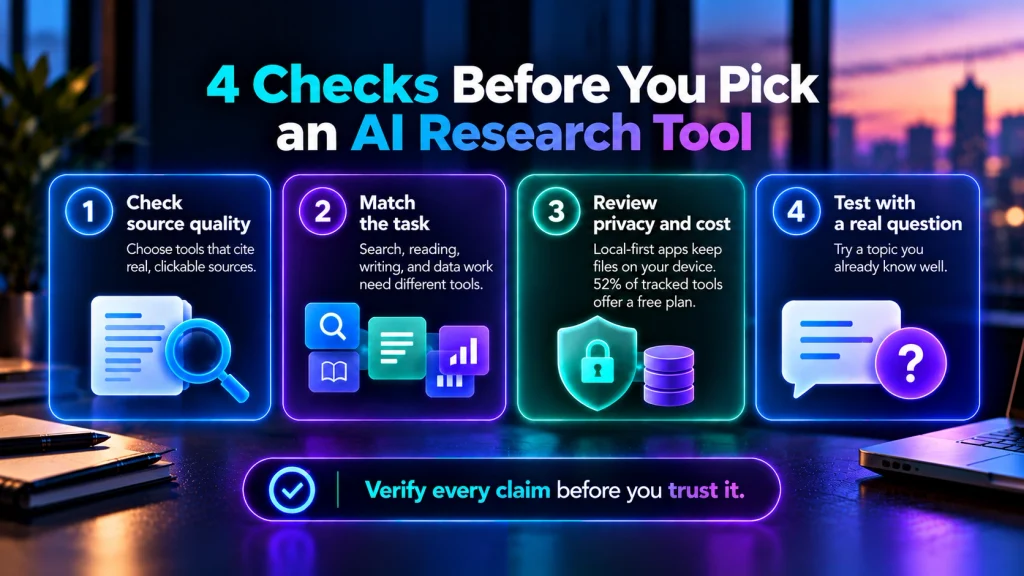
Start with a clear goal. Then use the checks below to compare each AI research tool fairly.
- Check Source Quality
Start by examining the provenance of the answers. You will want an AI research tool of substance to back up its claims with sources that are retrievable and real, and one that allows for a click through to the original text. Steer clear of anything that offers a confident response without putting in the references.
- Match the Tool to Your Task
Then consider what stage of your workflow you are in. There is a different set of requirements for data analysis than there is for writing or a literature search. Elicit, for instance, is well suited to the discovery side of things, whereas NVivo and ATLAS.ti are made for coding interview data.
In short, do not expect a single AI tool to be all encompassing. As Bluehost will tell you, it is common practice to make use of two or three tools in combination.
- Review Privacy and Cost
You should also give some thought to the way a vendor manages your files. With cloud-based tools, for instance, your notes are put on remote servers; a local-first approach will have them stay on your device. Then there is the matter of free tiers. According to Toolradar, 52 percent of the software it follows has a free plan available, which is an opportunity to put it to the test before parting with any money.
- Test With a Real Question
To be sure of what you are getting, try running through a question you are familiar with. See if the AI research tool can turn up the right papers and explain them in plain terms. Or whether it will concede when the evidence is not strong.
In the end, such answers are more telling than a feature list could ever be.
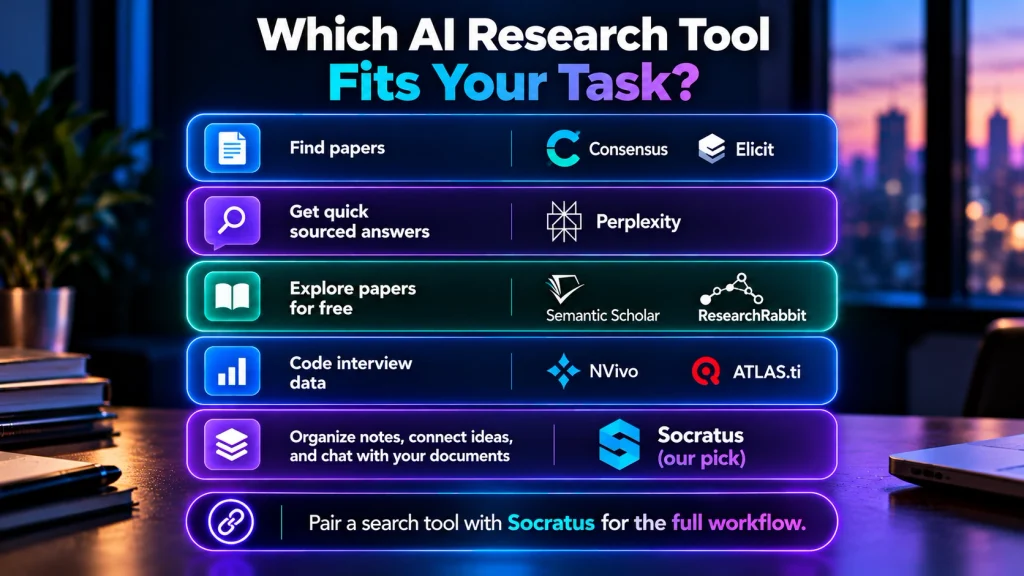
Top AI Research Tool Options by Use Case
Different jobs need different tools, so this section sorts each AI research tool by use case. Our overall pick is Socratus, covered in its own section below. Prices and features change often, so confirm details on each vendor site.
| Tool | Best for | Standout strength |
| Socratus (our pick) | Connected notes and private research | Chat, graph, and code in one local-first workspace |
| Consensus | Evidence from papers | Peer-reviewed search with citations |
| Elicit | Literature reviews | Narrows hundreds of papers to the best few |
| Perplexity | Quick sourced answers | Real-time answers with sources |
| NVivo and ATLAS.ti | Interview data | AI-assisted coding of transcripts |
- Consensus for Evidence-Based Answers
By sifting through peer-reviewed literature, Consensus illustrates the degree of agreement among studies on a given matter. An independent ranking put it at number one, awarding a 4.3 from editors. For clinicians and graduate students in need of solid, verifiable citations, it is an ideal first port of call for AI-assisted research in the sciences.
- Elicit for Literature Reviews
Then there is Elicit, which is all about locating and putting papers side by side for comparison. Reviewers will tell you it is a top pick for systematic reviews; the tool can whittle down hundreds of papers to the handful that merit a close read. For that reason, it is regarded by many in academia as the premier AI option for review work.
- Perplexity for Fast, Sourced Answers
With Perplexity one can get real-time answers and the sources to back them up, making it well suited for a quick check of the news or the market. There is a free tier available as well. Do not take the summaries at face value though; they may lack nuance, so make sure to verify the links. It is best used as an AI research tool for initial scouting before going deeper on your own.
- ChatGPT, Claude, and NotebookLM for General Help
For more involved work such as document queries, outlines or lengthy reports, the general assistants are the way to go. WsCube Tech would have you put ChatGPT with Deep Research in that category for its all-around capabilities and structured reporting. Then there is NotebookLM for when you need to put questions to your own uploaded files. But be wary of these tools putting in citations of their own invention. A good practice is to run each reference by eye and pair a general purpose AI with something more citation oriented to keep things in balance.
- Semantic Scholar and ResearchRabbit for Free Discovery
There is no charge for using Semantic Scholar. With ResearchRabbit you can map out related papers; the service has plans that run from free to roughly $12.50 a month per user. Either one will do in terms of letting you get your bearings on a subject before parting with money for an AI research tool.
- NVivo and ATLAS.ti for Interview Data
For qualitative researchers who have to code interviews and surveys on a large scale, there are tools like NVivo and ATLAS.ti. They employ AI to find patterns in transcripts, making them well suited to social science and user research. If your data is of the human variety rather than academic papers, this is the kind of AI tool to go with.
Why Your Notes Need an AI Research Tool Too
It is not enough to simply locate your sources; that is only part of the equation. One has to be able to put what was read to use, to make connections and recall it later. Yet for all the note apps on the market, they are content to store text without any real comprehension, leaving your ideas to languish in a folder.
There is a reason for the popularity of AI knowledge management tools. They close that divide by arranging notes according to their meaning rather than file structure and will even field questions on your writing. You could say they take the concept of an AI research tool and apply it to the actual utilization of sources, not just the search for them.
What These Apps Do
Personal knowledge management means collecting, organizing, and reusing what you learn. Modern apps support it with a few common features:
- AI chat that answers from your own documents
- Meaning-based search across all your notes
- A knowledge graph that shows how ideas link
- Local storage that keeps files on your device
- Tables and code blocks that sit beside your writing
How to Use Them Well
Use your notes app after you collect sources with a literature tool. Then add your own summaries and ask questions across them. As a result, a notes-based AI research tool turns scattered reading into a searchable archive.
Why Socratus Is Our Top AI Research Tool Pick
Socratus earns our top spot because it covers the whole thinking process in one place. Most tools above help you find papers. In contrast, this AI research tool helps you understand, connect, and reuse them. FiveRivers Technologies builds it, and the official site calls it a second brain for connected thinking.
Why Socratus Wins
- One workspace: AI chat answers from your own documents
- Meaning-based search: it finds notes by idea, not just exact words
- A visual knowledge graph that shows how your notes connect
- Built-in Python, calculations, and charts beside your writing
- Local-first storage and built-in encryption that keep files on your device
- Apps for Windows, macOS, iOS, and Android
How It Compares
Consensus and Elicit excel at finding papers. Perplexity excels at quick sourced answers. Socratus wins after that step, because it organizes what you found and lets you question it. Therefore, the strongest workflow pairs a search tool with Socratus.
Pricing and Limits
The free plan includes every core feature with up to 10 active files. Paid plans remove that cap, and prices vary by platform. Check the official site for current details. Socratus presents itself as a notes workspace, so it complements paper search instead of replacing it.
Ready to test it? Download Socratus for free and try it on one real project.
How an AI Research Tool Improves Discovery
Connections are what make for good research. A keyword search will turn up the exact words one types in, but it is no match for an idea put into different language and so it is easily overlooked. With a contemporary AI tool, one can read for meaning.
There is value in Knowledge Discovery coming across useful ideas you were not set on finding. An AI of this sort will surface a link between a note on burnout and an older one about sleep without any prompting. The result is that patterns are spotted in short order.
The software does the work behind the scenes by mapping out the semantic ties among your papers, notes and topics. Put simply, it figures out which concepts belong in the same vicinity and presents them as a visual graph. It is also capable of drawing attention to sources that have been missed.
Three simple habits boost your results:
- Write notes in full sentences, not fragments.
- Record the source for every claim.
- Review your graph weekly and add missing links.
As a result, your AI research tool grows more useful as your notes grow.
Managing Data with an AI Research Tool
You cannot have good answers without well-maintained data. That is the premise of Research Data Management, which is concerned with the organization, storage and sharing of your files as much as their preservation. The FAIR principles – findable, accessible, interoperable and reusable – are at the heart of it, as you will see in library guides like the one from PSDI.
Any AI research tool will perform to a higher standard if you cultivate the right habits. We recommend the following: be consistent with your folder structure and file names; document the provenance of every dataset; and maintain versions for the sake of an audit trail. Put backups in multiple locations and encrypt anything that is private.
Then there is the matter of compliance. UCLouvain notes that journals and funders are making it more of a requirement to put forward a data management plan. It is better to do some planning at the outset than to have to tidy things up after the fact. For that reason, make use of the structured tables in your notes; most note apps have smart ones these days with charts and calculations to put ideas and figures in the same view.
In the end, an AI tool can only process what is put before it. Messy inputs will yield messy results, so ensure the data going in is clean and the insights you get out will be all the more reliable.
Tips for Using an AI Research Tool Responsibly
Trust matters more than speed. These tips keep your work accurate and ethical.
- Verify Every Claim
It is well worth opening up every source you have cited to read the relevant passage for yourself. Even when an AI research tool has a valid link, its summaries can be off the mark. Consider them no more than a place to begin.
- Keep Humans in Charge
The onus is on you to draw your own conclusions. Let the AI do the legwork of searching and sorting, or put together a first draft, but make sure to bring your own voice and judgment to the piece, along with the necessary context. And of course, be mindful of whatever guidelines your employer or school has in place regarding the use of AI.
- Protect Sensitive Information
One should not put confidential information into a tool without first reviewing the privacy policy. Local-first applications are a way to mitigate that sort of risk, as they keep files on your own device.
- Cite the Tool Honestly
It is also good practice to make a note of the AI research tool employed and the task at hand. Such transparency will go a long way in having readers put their trust in your work.
Stay Current
Features and prices change fast. Hence, recheck each AI research tool every few months.
FAQs
- What is the best AI research tool for students?
For locating papers, one can do well with Consensus or Elicit; there is also the option of Semantic Scholar at no cost. Ultimately, what makes for the ideal AI research tool is a matter of budget and the demands of the assignment.
- Can an AI research tool replace a manual literature review?
It is not a substitute for your own work. While an AI tool will hasten the process of searching and summarizing, the onus remains on you to read the important papers and make your own assessment of the evidence.
- Is an AI research tool accurate?
Accuracy varies. Tools that cite real sources perform better than general chatbots. Still, verify every claim before you use it.
- Are there free AI research tool options?
Then there is the question of accuracy. You will find that tools which put in citations from actual sources are more reliable than a run of the mill chatbot, but it is prudent to check every claim before putting it to use.
- How do I keep my data safe with an AI research tool?
Read the privacy terms first and skip confidential files. Local-first apps also keep your data on your device.
Final Thoughts on Choosing the Best AI Research Tool
When it comes to the best AI research tool, the answer depends on what one is trying to do. We put our money on Socratus for private, connected work. If the task is to locate papers, Consensus and Elicit are hard to beat; for a fast check there is Perplexity. And interview data is best left to NVivo or ATLAS.ti. In the end, Socratus is what you need to bring your findings into a single, secure workspace.
Our advice is to begin in modest fashion. Select an AI tool for source discovery and use Socratus to put your notes in order. Put them to the test with a question you know well and stick with the combination that yields answers you can verify and make sense of.
Do not forget to safeguard your data and confirm any claims. Proper habits are as important as the software itself. Why not give it a go? A free download of Socratus is available today to help you put together a second brain. Leave the drudgery to the tool and remain curious. Steady practice with the right AI at your side will see your research become both swifter and more transparent.