Why Traditional Note Apps Fail Researchers (And What Comes Next)
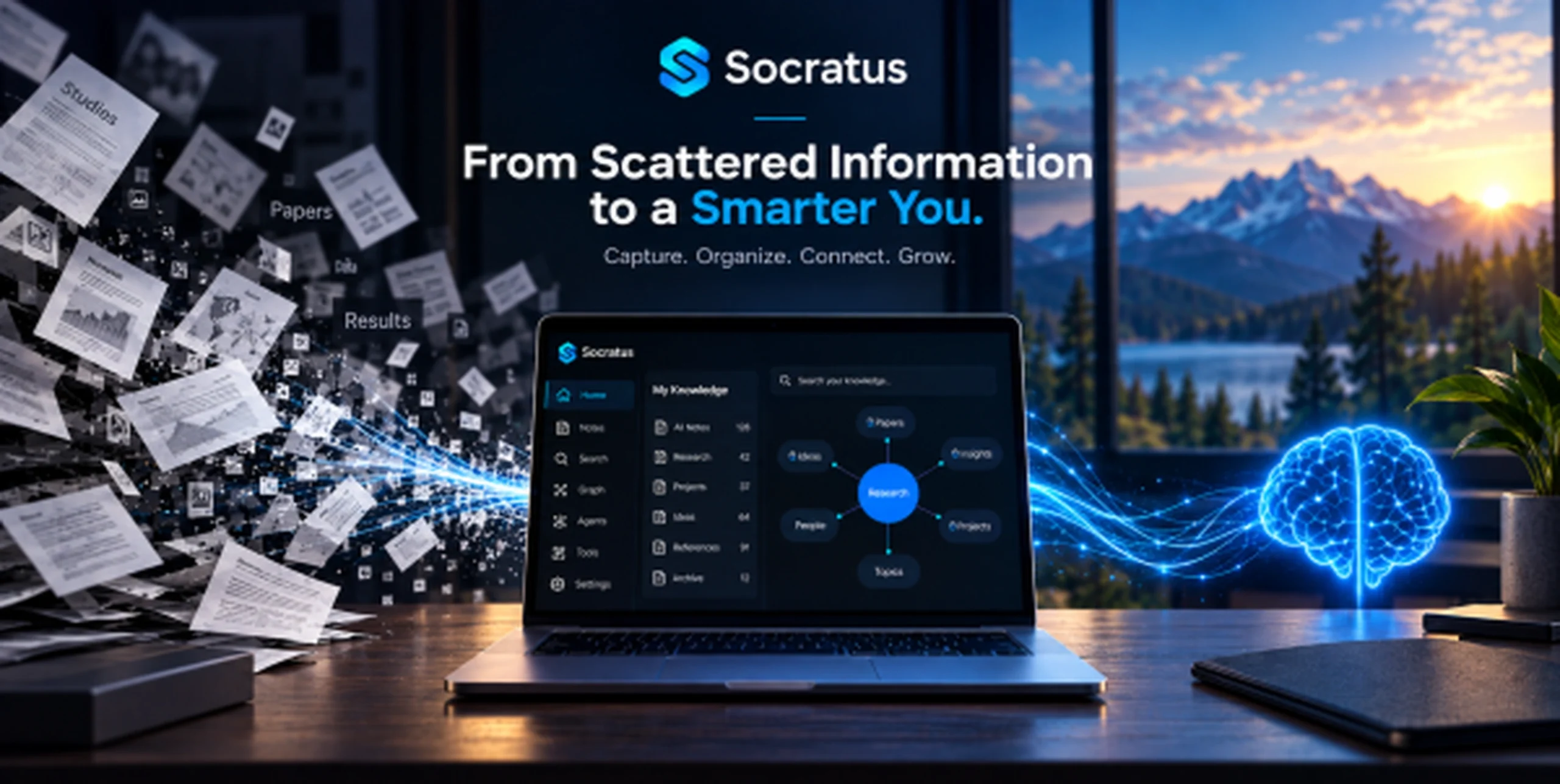
Do a literature review, and you are left with an array of open browser tabs, PDFs, and sticky notes. Then, some weeks later, a telling quote has vanished into the depths of a folder that no one can put a name to. Call it a structural failing rather than a lack of discipline. The fact is that your average notebook or folder-based app lacks the capacity for the connections and volume that research requires.
Researchers are better served by a system of personal knowledge management, something designed to put sources at hand, make the links between ideas, and have findings on tap when the project requires them. Conventional tools do little more than store; they do not help you make sense of hundreds of sources at once. The price of such a deficiency is not merely time wasted; it is a tacit contributor to the reproducibility issues that are the bane of so many fields.
This guide explains how the usual note apps are inadequate in a research context and presents a more intelligent, connected alternative.
The Real Cost of Weak Personal Knowledge Management in Research
Weak personal knowledge management rarely announces itself early. One does not see it all at once; it is a matter of small delays the researcher tolerates. An hour or more may be spent tracking down a missing citation, or there may be no answer on a methodological point because the notes are no longer available. In and of itself it is hardly a crisis. But in the context of a project spanning several years, the toll is measurable and very real.
Fragmented Tools Create Fragmented Thinking
One does not locate all the research in a single spot. The learning portal has the deadline, an email will bring some clarification, a collaborator will put in a new meeting time on chat, and the notes are to be found in another place altogether.
In isolation, each tool is adequate for its purpose, but when used together, they leave the researcher with fragmented responsibility and as the sole means of keeping order. For a project that will run over several years, such an arrangement hardly sustains itself. Weak personal knowledge management turns into a hidden tax on every literature review.
When Missing Documentation Becomes a Reproducibility Problem
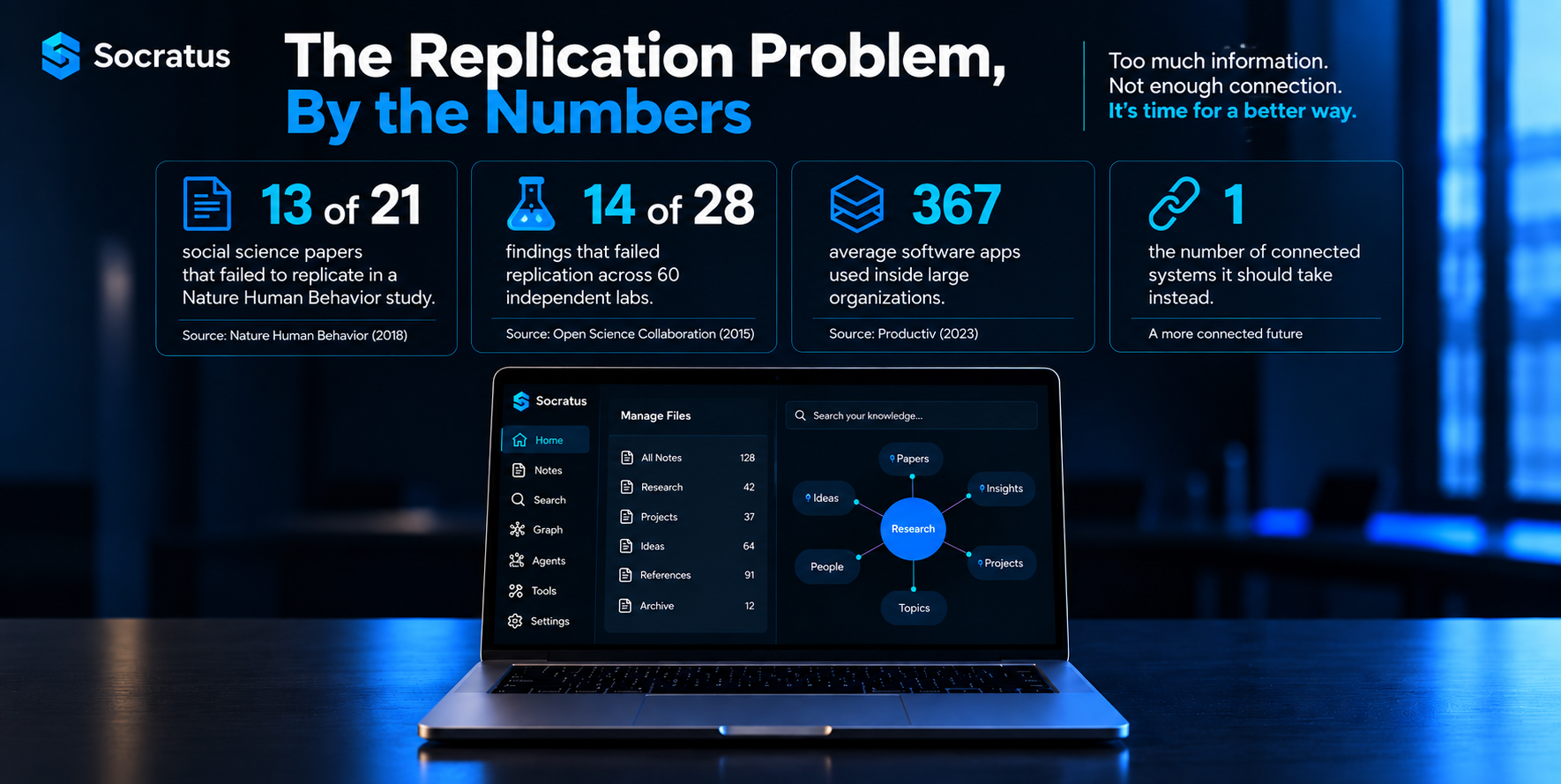
It is not a matter of wasted hours. In many areas of science, the reproducibility crisis has its roots in documentation as much as in statistics. If the reasoning, code, or research data are not recorded for posterity, it is impossible to verify them later, even by the original researcher.
One need only consider a well-cited study in “Nature Human Behaviour” for an example. During its review, it could not test more than half of the social science papers at hand and obtain the same results. For that kind of failure, poor research data management is not a peripheral matter; it is the root of the problem.
Why Traditional Note Apps Struggle with Research Workflows
Folder Structures Don’t Scale with Literature Reviews
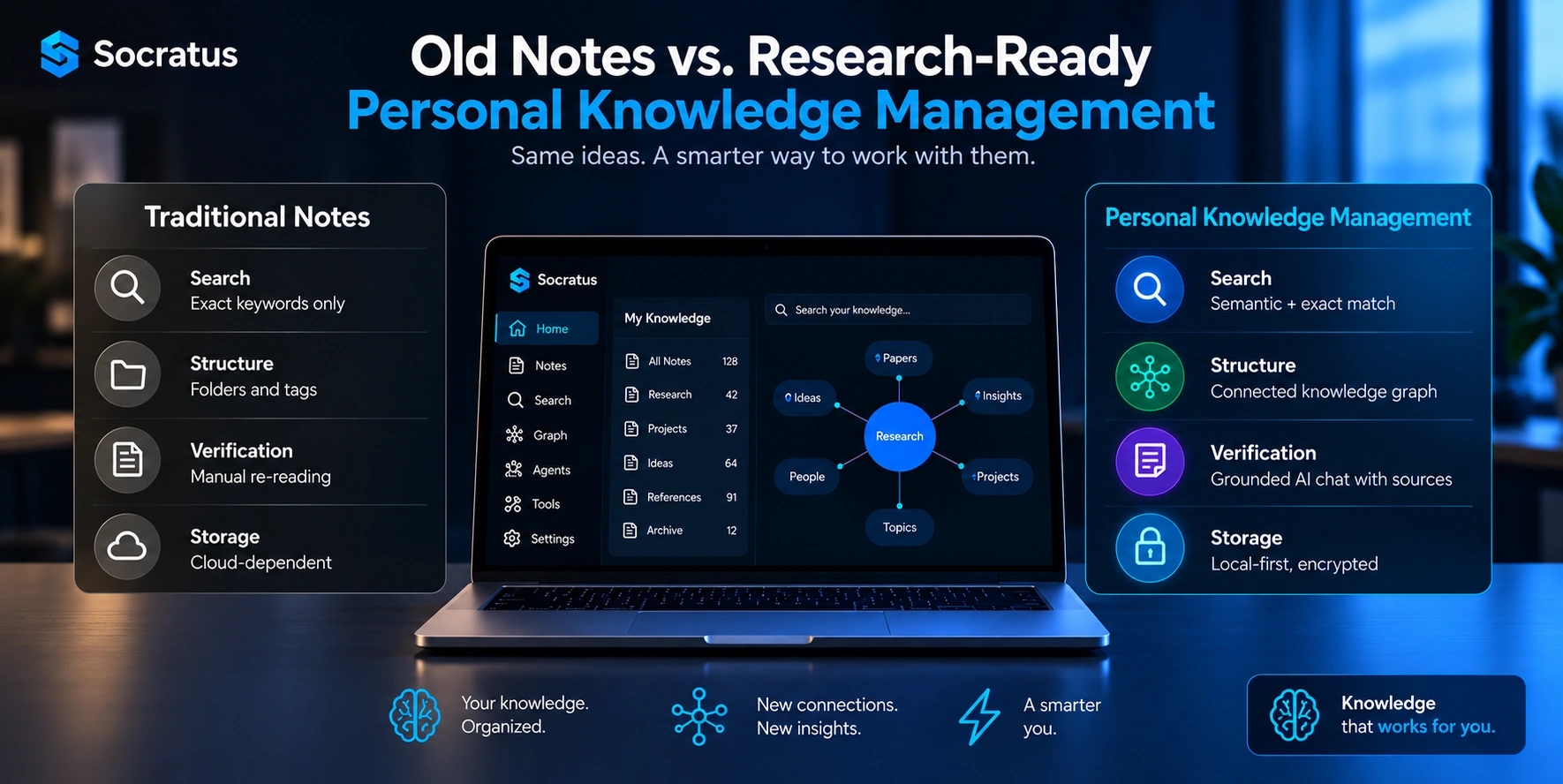
Notebooks and tags work for a few sources, but at fifty they are inadequate, and by two hundred they fail. The structure of Evernote illustrates this point: it relies on notebooks and tags rather than any kind of networked relationship between ideas. For putting things away, that is sufficient. Yet it will not explain how the methodology of one paper might conflict with a result from another paper that is three folders away.
Search Without Meaning Wastes a Researcher’s Time
A plain keyword tool will turn up nothing if the source has “cognitive load” and one puts in “mental effort,” since for the most part built-in search is limited to exact word matches. That is the province of information retrieval as a discipline; a proper system will rank based on what is meant, not how it is spelled. Notes apps have been slow to adopt such an approach, forcing researchers to review sources they have already tested.
What Comes Next: Personal Knowledge Management Built for Research
Retrieval That Understands Meaning, Not Just Keywords
With a modern system, one can turn a note into a number that stands for its meaning and have the query run against it as opposed to the text in its raw form. Should two notes have an overlap of meaning, they will come up in tandem even if the words are not at all the same. In this way, this one change mostly puts to rights the kind of fruitless searching mentioned earlier.
Knowledge Graphs That Reveal Hidden Connections
Knowledge graphs turn a pile of sources into a map. Each note becomes a node. Each shared idea becomes an edge connecting two or more nodes. Instead of scrolling through folders hoping to remember a connection, a researcher can see it rendered visually, scored by similarity, and ready to explore.
An AI Note Taking App Grounded in Your Own Sources
An AI note taking app built for research should never answer from the open internet. It should answer only from the sources you’ve collected and show exactly which one it pulled from. That distinction protects academic integrity while still saving hours of manual searching across a growing archive.
Inside Socratus: A Research-Ready Personal Knowledge Management System
The whole of Socratus has been put together to address the very thing this piece identifies, namely research notes that accumulate and are left to their own devices. One will not find a folder tree with a search bar tacked on; in Socratus each note and source is an element of a single searchable archive, all of it tied together.
Semantic and Exact Search, Side by Side
Take a literature review where the papers do not agree on their terminology. With Socratus, a semantic search is in play as well as the more conventional exact-word variety. Put in “mental workload” and the system will bring up a source that may have used “cognitive load” exclusively. The two modes are not at odds; they are meant to run in concert so nothing is overlooked for lack of the right phrasing.
A Relationship Graph Built for Cross-Referencing Sources
Socratus will score a note in the workspace against all the others. With a click on the relation tree icon, you can display those links in an interactive graph that includes color coding. A researcher with a dozen or more papers to contend with would otherwise be at it for months doing the cross-referencing by hand; here it is done and made plain in a matter of seconds and can be put out as an image for the purposes of a lab meeting or the methods appendix.
AI Chat Grounded Only in Your Own Sources
For its responses, the AI Chat is confined to what is in a selected folder of documents; it will not look to the open internet. A source panel accompanies each response, showing the note or paper from which the answer was drawn. This kind of traceability is of importance in research; if an answer cannot be checked against an actual source, it has no value for a citation, however sure it may seem.
Local-First Storage for Data That Can’t Leave Your Control
As a matter of course, one keeps unpublished research notes or IRB-subject data off third-party servers. Socratus is designed to keep all such material in the form of portable, plain text files where you want them, be that on your device or some cloud storage of yours. And if there is a file of a sensitive nature, a right-click will see it encrypted at the file level with no disruption to how one works.
In-Note Code Execution for Data-Heavy Work
With Socratus, one can execute Python from within a note, obviating the need to open another notebook for some data cleaning or an initial round of exploration and statistical checks. The written account includes the produced charts and relevant tables, making the reasoning and data traceable in a single file instead of multiple documents.
MCP Integration for AI-Assisted Research Workflows
With the Model Context Protocol, Socratus puts your research archive at the disposal of AI agents such as Claude in the form of live context. An agent can be put to work on restructuring some notes, drawing out pertinent sources or providing a folder summary; it will do so on the basis of material you have seen fit to vet rather than have a general model make its best guess.
Building a Research Workflow That Actually Holds Up
A good deal of consistency is preferable to a setup that is flawless but arrived at too late. When you come across a source, put it in the system right away, including the page or paragraph number. There is no need to go back over your notes from days past to make the links when something new is raised; let the relationship graph in the system see to that. Make it a practice to look over any flagged connections on a weekly basis, not only as a deadline looms.
And for the reasoning behind the data, record it in the same place rather than in some other file that is left to its own devices and out of sync. During a project, such discipline is what will keep one from the sort of unproven, poorly documented tangle that can do an otherwise sound piece of research in.
Frequently Asked Questions About Personal Knowledge Management for Research
What is personal knowledge management for researchers?
Personal knowledge management is a system for capturing, connecting, and retrieving research sources and notes, so findings resurface exactly when they’re needed again.
How is this different from a reference manager like Zotero?
Reference managers organize citations. A full personal knowledge management system also connects the ideas and findings inside those sources to each other.
Does better information retrieval really reduce reproducibility problems?
Not on its own, but it removes a major cause: undocumented reasoning. Strong information retrieval makes past decisions easy to trace and verify later.
Can knowledge graphs help during a live literature review?
Yes. A knowledge graph surfaces related papers automatically, which shortens the sometimes weeks-long process of manually re-reading old sources for connections.
Is local-first storage important for research data management?
Often yes, especially with unpublished or sensitive data. Keeping files under direct local control reduces dependency on third-party servers and access policies.
The Bottom Line
Old note apps do not have the design needed to accommodate the scale and stakes of genuine research. Their folder hierarchies, keyword searches, and tools that do not communicate with one another waste a researcher’s time; if reasoning cannot be tested later, credibility can also suffer. What is needed is a form of personal knowledge management with retrieval that understands meaning, a knowledge graph to lay out connections for all to see rather than obscure them, and local storage to put sensitive data where the researcher wants it. Socratus has made a single workspace of these three things, allowing literature reviews to compound.
After all, the instruments at a researcher’s disposal ought to facilitate the tracing of one’s reasoning, not impede it. The change is overdue and is already happening.
Want to fast-track your research workflow?